



Importing automotive lights from China can be a profitable opportunity for automotive parts wholesalers, distributors, repair shops, and vehicle modification businesses. China has an extensive automotive lighting supply chain, offering a wide selection of replacement headlights, LED taillights, fog lamps, daytime running lights, and customized aftermarket lighting products.
However, successful importing involves more than finding a supplier with competitive prices. Buyers need to verify product compatibility, evaluate manufacturing quality, understand import regulations, calculate landed costs, and establish reliable shipping and after-sales arrangements.
This guide explains how to import automotive lights from China in 2027, from supplier selection and sample testing to bulk purchasing, customs clearance, and long-term cooperation with a Chinese automotive lighting manufacturer.
Why Import Automotive Lights from China in 2027?
China is an important sourcing destination for automotive lighting products because buyers can access a broad supplier base, different price levels, and various customization options.
For B2B buyers, importing directly from a suitable manufacturer may help improve purchasing efficiency, expand product selection, and build a more competitive aftermarket lighting business.
Competitive Pricing and Manufacturing Capabilities
Chinese automotive lighting suppliers serve a wide range of markets, including replacement parts, aftermarket upgrades, and vehicle modification accessories.
Depending on the supplier, buyers may be able to source complete lamp assemblies, individual lighting components, customized designs, and products for specific vehicle applications.
Working directly with a manufacturer may also reduce unnecessary purchasing intermediaries. However, the lowest quotation does not always represent the lowest total cost. Product quality, packaging, defect rates, freight, duties, and warranty costs should all be considered.
A Wide Range of Automotive Lighting Products
Importers can source several categories of automotive lights from China:
LED headlights and headlamp assemblies
Replacement taillights and rear lamp assemblies
Fog lights and daytime running lights (DRLs)
LED turn signals and auxiliary lighting
Modified headlights and customized taillights
Lighting assemblies for pickup trucks and off-road vehicles
Popular applications may include Toyota Hilux, Ford Ranger, Ford F-150, Toyota Land Cruiser, and selected GWM Tank models. Actual availability depends on the manufacturer's product range and vehicle fitment.
OEM Replacement and Aftermarket Customization Options
Automotive lighting buyers generally serve two different markets.
Replacement lighting: Designed to replace damaged, worn, or defective original lamps. Buyers typically prioritize fitment, functional performance, appearance, and compliance with applicable regulations.
Aftermarket modification lighting: Designed for customers who want a different appearance or additional styling features, such as distinctive LED designs, sequential turn signals, or customized light signatures.
Wholesalers should identify their target customers before placing an order. A repair-parts distributor may prioritize standard replacement products, while a modification shop may prefer distinctive designs with stronger visual appeal.
Advantages of Working Directly with a Chinese Manufacturer
Direct factory cooperation can offer several potential benefits:
Access to product catalogs and fitment information
Direct communication about specifications and customization
Better visibility into production and inspection processes
Opportunities to negotiate bulk pricing and packaging
A more consistent process for repeat orders
These advantages depend on the supplier's actual capabilities. Importers should verify factory status, quality procedures, and export experience instead of relying on marketing claims alone.
What Types of Automotive Lights Can You Import from China?
Before contacting suppliers, create a clear product list based on your customers, vehicle applications, and expected sales volume.
LED Headlights and Headlamp Assemblies
Headlights are an important category for replacement-parts distributors and vehicle upgrade businesses.
When sourcing headlights, check:
Compatible vehicle model and production year
Left-hand-drive or right-hand-drive application, where relevant
Low-beam and high-beam functions
Light source and electrical specifications
Connector type and installation requirements
Beam pattern and applicable regulatory compliance
Do not assume that a headlight fits every version of the same vehicle. Different trims, markets, and model years may use different assemblies.
Automotive Taillights and Rear Lamp Assemblies
Taillights are widely used in collision repair, maintenance, and vehicle customization markets.
Common products include standard replacement rear lamps, LED taillights, smoked-lens styles, and modified assemblies for pickup trucks and SUVs.
For example, a wholesaler serving Toyota Hilux owners may stock several model generations rather than purchasing a single universal design.
Before ordering, confirm the vehicle generation, model year, body configuration, lamp position, connector, and included components. Specify whether the quotation covers one lamp or a complete left-and-right pair.
Fog Lights and Daytime Running Lights
Fog lamps and DRLs can complement a supplier's headlight and taillight range.
Important checks include mounting dimensions, electrical compatibility, operating functions, waterproofing, and local rules governing the use of auxiliary lights.
If these products are sold as part of a vehicle-specific kit, confirm whether brackets, wiring, switches, and installation instructions are included.
Modified and Custom-Style Automotive Lights
Modified lighting can help distributors differentiate their inventory from standard replacement products.
Possible options include distinctive LED elements, sequential indicators, customized lens appearances, and different lighting configurations.
Before purchasing, ask the supplier to identify which features are included in the standard product and which require customization. Request samples, functional demonstrations, and documentation for the exact configuration you intend to sell.
A lighting design that looks attractive in photographs may still require additional testing to verify its electrical performance, installation compatibility, and road-use compliance.
How to Find a Reliable Automotive Lighting Supplier in China
Supplier selection is one of the most important steps in the importing process. A reliable partner should be able to provide accurate product information, consistent quality, clear commercial terms, and responsive communication.
Verify the Manufacturer's Factory and Production Capabilities
Start by asking whether the company is a manufacturer, trading company, or a combination of both.
Useful verification steps include:
Requesting a company profile and factory address
Arranging a live video tour or an independent factory audit
Reviewing production and assembly equipment
Checking the quality inspection process
Asking which production stages are performed in-house
Requesting references or examples of previous export orders, where available
A supplier does not necessarily need to manufacture every component internally. However, it should clearly explain its production arrangements and responsibility for final product quality.
Check Automotive Lighting Quality Control Procedures
Ask how the supplier inspects incoming materials, assembled products, and finished lamps.
Depending on the product, quality checks may cover:
Lens and housing appearance
Assembly fit and sealing
Electrical connections and functional operation
Light output and beam performance
Moisture resistance and environmental testing
Packaging and shipping protection
Request sample inspection records or test reports where available. Make sure the documents relate to the specific product and configuration being purchased.
Confirm OEM Fitment and Vehicle Compatibility
Fitment errors can lead to costly returns and dissatisfied customers.
Provide the supplier with the vehicle make, model, model year, generation, trim level, and market version. Where possible, include an original part number, reference photographs, connector photographs, and mounting measurements.
Ask the supplier to confirm compatibility in writing and identify any exclusions.
Do not rely exclusively on a listing title such as "fits Toyota Hilux." Confirm the exact application before approving a bulk order.
Review Certifications and Export Experience
Ask which certifications, approvals, test reports, or declarations are available for the products you plan to import.
The appropriate documentation depends on the destination country, lamp category, intended use, and whether the product is intended for public-road use.
A company's general quality-management certificate does not automatically establish that every lighting product complies with the applicable vehicle-lighting regulations.
Compare Factory-Direct Suppliers and Trading Companies
Both manufacturers and trading companies can be useful sourcing partners.
A manufacturer may offer more direct access to product engineering, production scheduling, and customization. A trading company may provide a broader range of products from different factories.
Compare suppliers using the same product specification, order quantity, packaging requirements, delivery terms, warranty conditions, and documentation requirements.
The objective is not simply to find the cheapest supplier. It is to identify the partner that can deliver the correct product consistently at a commercially viable total cost.
Step-by-Step Guide to Importing Automotive Lights from China
Step 1: Research Your Target Market and Product Demand
Identify the vehicle models and lighting products that your customers purchase most frequently.
For example, a distributor specializing in pickup accessories may focus on Toyota Hilux, Ford Ranger, and Ford F-150 lighting. A repair-parts wholesaler may prioritize standard replacement headlights and taillights across a wider vehicle range.
Research local competitors, retail and wholesale price levels, vehicle populations, customer preferences, and import requirements.
Start with a manageable product range rather than ordering too many low-volume SKUs.
Step 2: Identify Suitable Automotive Lighting Manufacturers
Search for manufacturers with relevant products and export experience.
Useful search terms include:
Automotive lighting manufacturer in China
Wholesale LED headlights supplier
Replacement taillight manufacturer
OEM automotive lamp supplier
Aftermarket pickup truck lighting supplier
Review each supplier's product catalog, fitment information, available documentation, communication quality, and production capabilities.
Contact several qualified suppliers so you can compare quotations using consistent requirements.
Step 3: Request Product Catalogs, Quotations, and Samples
When requesting a quotation, provide enough information for the supplier to price the correct product.
Your request should include:
Product name and reference photographs
Vehicle make, model, and production year
Required quantity for each SKU
Standard or customized specifications
Packaging and labeling requirements
Destination country and delivery address or port
Required certificates or test documentation
Request samples for evaluation before committing to a large order, especially for unfamiliar products or customized lighting assemblies.
Step 4: Confirm Specifications, Fitment, and Packaging
Create a written product specification sheet for each SKU.
Confirm dimensions, connectors, functions, materials, included accessories, packaging, and vehicle compatibility.
For lighting products, also specify the required light source, color functions, beam configuration, and applicable compliance requirements.
Ask the supplier to document any differences between the sample and the final production specification.
Step 5: Negotiate MOQ, Pricing, and Payment Terms
MOQ means minimum order quantity. It varies by supplier, product, production process, and customization requirements.
A standard replacement lamp may have different purchasing requirements from a newly designed customized assembly.
When negotiating, discuss:
Unit price at different order quantities
MOQ for each product and design
Sample charges and whether they can be credited against an order
Tooling or customization fees
Production lead time
Payment milestones
Warranty and defect-handling arrangements
Avoid judging quotations without confirming whether they cover the same specifications and quantities.
Step 6: Arrange Production and Quality Inspection
After approving the sample and purchase order, agree on the production schedule and inspection criteria.
For larger orders, consider a pre-shipment inspection performed by your team, the supplier's quality department, or an independent inspection company.
The inspection should verify the order quantity, product appearance, fitment details, electrical functions, packaging, and any agreed test requirements.
Document acceptable quality limits and the procedure for handling nonconforming products before production begins.
Step 7: Organize Shipping and Customs Clearance
Choose a shipping method based on the order size, urgency, budget, and destination.
Before shipment, confirm the commercial invoice, packing list, transport document, customs classification, origin information, and any product-specific compliance documents required by the destination country.
Agree who is responsible for export clearance, international freight, insurance, import clearance, and local delivery.
Using a freight forwarder or customs broker experienced in automotive parts can help reduce documentation errors and unexpected delays.
How Much Does It Cost to Import Automotive Lights from China?
The total cost depends on the product, order volume, customization, shipping method, and destination market. There is no single price that applies to all automotive lighting products.
Product Prices and Minimum Order Quantities
Unit prices may vary significantly between basic replacement lamps and complex customized LED assemblies.
Pricing can also depend on housing and lens materials, internal electronics, LED components, tooling, packaging, and testing requirements.
Ask suppliers to quote several order quantities so you can understand how unit costs change with volume.
Sample, Tooling, and Customization Costs
Samples may involve product charges and courier fees. Customized products may also require tooling, design work, prototype development, or additional testing.
Before approving customization, confirm who owns the tooling, whether the tooling fee is refundable or creditable, and whether the supplier may use the design for other customers.
International Shipping and Insurance Costs
Automotive lamps require packaging that protects lenses, housings, mounting tabs, and electronic components.
Air freight may be suitable for urgent or relatively small orders. Sea freight may be more economical for larger shipments, although transit time and destination handling charges must be considered.
Request a freight quotation based on the actual carton dimensions, gross weight, shipping terms, and destination.
Import Duties, Taxes, and Customs Clearance Fees
Duties and taxes depend on the importing country, customs classification, customs value, origin rules, and applicable trade measures.
Ask a customs broker to confirm the correct tariff classification and estimated charges before placing the order. Do not assume that all automotive lamps use the same customs code or tax rate.
How to Calculate the Total Landed Cost
A practical landed-cost calculation is:
Total landed cost = Product cost + Packaging and tooling + Export charges + International freight + Insurance + Import duties and taxes + Customs clearance + Local delivery
Divide the total by the number of saleable units to estimate the landed cost per unit.
For example, if a shipment contains multiple SKUs, allocate shared freight and clearance charges using a consistent method, such as weight, volume, or shipment value, where appropriate.
Then compare the landed cost with your expected wholesale selling price and operating expenses. This provides a more useful picture of profitability than the factory unit price alone.
Automotive Lighting Certifications and Import Regulations in 2027
Regulatory compliance should be checked before you order samples or approve mass production. Requirements vary by market and by the function of the lamp.
E-Mark and UN Regulations for Applicable Markets
Certain automotive lighting products intended for markets applying relevant UN vehicle regulations may require type approval and appropriate approval markings.
For example, UN Regulation No. 148 covers light-signalling devices, while UN Regulation No. 149 covers road-illumination devices and systems. The applicable requirements depend on the product category and relevant regulatory framework. Official UN Regulation No. 148 and UN Regulation No. 149.
Do not assume that one approval applies to every headlight, taillight, or auxiliary lamp. Ask for documentation corresponding to the exact product and intended market.
DOT and FMVSS Requirements for the US Market
In the United States, Federal Motor Vehicle Safety Standard No. 108 addresses lamps, reflective devices, and associated equipment. It includes requirements relevant to original and replacement vehicle lighting. Official FMVSS No. 108 information.
Importers should verify which requirements apply to the specific lamp and vehicle application. Do not treat a supplier's use of the term "DOT" as sufficient proof of compliance.
Confirm the applicable certification responsibilities, required markings, technical documentation, and any other obligations with the manufacturer and a qualified compliance professional.
Saudi Arabia and Middle East Import Compliance
Importers serving Saudi Arabia and other Middle Eastern markets should check the destination's current vehicle-lighting, product-conformity, customs, and documentation requirements before shipment.
Requirements may differ between countries and between products intended for road use and auxiliary or off-road applications.
Ask your importer or local compliance adviser to confirm the current requirements for the specific product category. Obtain the necessary conformity documentation before dispatch rather than assuming that a product accepted in another country will automatically be accepted locally.
How to Verify Product Documents Before Ordering
Use a document checklist that includes:
The exact product model and manufacturer
Applicable approval or certification documents
Test reports and their scope
Relevant approval markings
Vehicle fitment and technical specifications
Required export and import documents
Check that model numbers, product photographs, specifications, and document details match. If you are unsure about the validity or scope of an approval, verify it with the issuing authority or a qualified compliance specialist.
How to Choose Between OEM Replacement Lights and Aftermarket LED Lights
The right product mix depends on your customers and sales channel.
OEM-Style Replacement Lights for Repair Markets
OEM-style replacement lights are intended to match the original installation and appearance as closely as specified for the application.
They can suit repair shops, replacement-parts wholesalers, and distributors serving customers who need to replace damaged lamps.
Priorities typically include fitment accuracy, reliable operation, consistent appearance, suitable packaging, and compliance with applicable requirements.
Aftermarket LED Lights for Vehicle Modification Businesses
Modified LED headlights and taillights may appeal to off-road accessory shops, pickup modification businesses, and aftermarket distributors.
Design options may include distinctive LED elements, sequential indicators, and customized appearance packages.
However, styling features must not be confused with verified performance or road-use approval. Check electrical specifications, installation requirements, light output, and local legality before marketing a product for public-road use.
How to Select the Right Product Mix for Wholesale Distribution
Consider these factors when building your catalog:
Customer demand: Focus on vehicle models and product categories with proven sales potential.
Price positioning: Include products suited to your target wholesale price range.
Fitment coverage: Stock the model years and configurations your customers actually need.
Product differentiation: Use customized designs where your market supports them.
Inventory risk: Start with a manageable range and expand based on reorder data.
Supplier consistency: Prioritize products with reliable quality and repeat-order availability.
A balanced catalog can combine standard replacement lamps with selected aftermarket upgrade options.
How to Ensure Automotive Lighting Quality Before Shipment
Quality problems can create returns, warranty expenses, damaged customer relationships, and additional shipping costs. Inspection criteria should be agreed upon before production.
Housing Material, Lens Quality, and Waterproof Performance
Inspect the housing, lens, seams, mounting points, and assembly finish for defects.
Depending on the design, suitable testing may include water-ingress resistance, environmental exposure, and checks for condensation or sealing problems. The required methods and acceptance limits should be defined for the specific product rather than assumed to be identical across all lamps.
LED Brightness, Light Pattern, and Electrical Performance
Check that the product performs according to the agreed specifications.
Depending on the lamp, tests may cover electrical input, lighting functions, beam pattern, light output, indicator operation, and other relevant performance characteristics.
For road-use lighting, ensure that the testing and documentation address the applicable regulatory requirements. A lamp appearing bright during a visual demonstration does not establish compliance.
Fitment Testing and Assembly Inspection
Where possible, test samples on the intended vehicle or a suitable fitment fixture.
Check mounting points, connector compatibility, clearances, panel alignment, and the installation process.
For a product range covering multiple vehicle generations, maintain separate fitment records for each applicable model and configuration.
Packaging Standards to Prevent Shipping Damage
Packaging should protect fragile lenses and mounting tabs during handling and transport.
Ask suppliers to confirm protective materials, internal separators, carton strength, labeling, and packing quantity. For larger shipments, review whether palletization or additional protection is appropriate.
If damage claims are a concern, retain photographs of packaging and inspection results before dispatch.
Warranty Policies and After-Sales Support
Agree on warranty coverage, the claim period, evidence requirements, and remedies for confirmed defects.
Clarify whether the supplier offers replacement products, replacement components, credit, or another agreed solution.
Document how defective items must be reported and whether the supplier needs photographs, videos, batch information, or returned samples.
Clear procedures make it easier for both parties to resolve problems efficiently.
Shipping Automotive Lights from China to International Markets
Sea Freight vs. Air Freight
Sea freight is often considered for larger orders when transit time allows. Air freight can be useful for urgent shipments, samples, or replenishment orders where speed justifies the additional cost.
Compare the full cost, including pickup, export handling, freight, insurance, destination charges, customs clearance, and delivery.
Ask the freight forwarder for an estimated transit time and confirm whether the quotation covers port-to-port or door-to-door service.
How to Choose Between FOB, CIF, and Other Incoterms
Incoterms define important responsibilities between the seller and buyer.
EXW: The buyer generally takes responsibility for collecting the goods from the agreed location and arranging subsequent transport.
FOB: For applicable sea or inland-waterway shipments, the seller delivers the goods on board the vessel at the named port of shipment.
CIF: For applicable sea or inland-waterway shipments, the seller arranges and pays for carriage and insurance to the named destination port, subject to the Incoterms rules.
FOB and CIF should not be treated as interchangeable with door-to-door delivery terms. Under CIF, the transfer of risk occurs at shipment, not when the goods arrive at the destination port.
Always specify the named place or port and the applicable Incoterms version in your purchase contract. Confirm which destination charges and import formalities remain your responsibility.
Documents Required for International Shipments
Common documents may include:
Commercial invoice
Packing list
Bill of lading or air waybill
Certificate of origin, where required
Product approvals or conformity documents, where applicable
Other documents required by the destination country
The exact requirements depend on the goods and destination. Have your freight forwarder and customs broker review the document set before shipment.
How to Reduce Shipping Costs for Bulk Orders
Consider consolidating compatible SKUs into a single shipment, improving carton utilization, and forecasting replenishment orders.
However, do not compromise protective packaging simply to reduce volume. Damage during transport can outweigh savings in freight costs.
Compare suppliers' packaging dimensions and packing methods, and evaluate the landed cost per saleable unit rather than freight cost alone.
Common Mistakes to Avoid When Importing Automotive Lights from China
Choosing Suppliers Based on Price Alone
A low quotation may exclude important features, testing, packaging, or after-sales support.
Compare like-for-like specifications and evaluate the supplier's quality system, delivery reliability, and defect-handling arrangements.
Ignoring Vehicle Model Years and Fitment Details
Similar vehicle names do not guarantee interchangeable lamps. Different generations, trims, markets, and body styles may use different parts.
Confirm fitment in writing and retain the approved product specification with your purchase order.
Overlooking Certification and Local Import Requirements
Do not wait until goods arrive to discover that additional documentation or product approvals are required.
Check the current destination-market requirements before production and verify that the documents apply to the actual products being ordered.
Ordering Large Quantities Without Testing Samples
A sample order can reveal differences in fitment, appearance, packaging, and electrical operation before you commit to bulk inventory.
Use a documented approval process for new products and customized designs.
Failing to Confirm Warranty and Defect Handling Terms
Verbal assurances can lead to disagreements later.
Specify the warranty period, claim evidence, response times, and agreed remedies in writing before making the deposit.
Why Choose HUAERRUI as Your Automotive Lighting Supplier in China?
For overseas buyers looking for automotive lighting and exterior accessories, HUAERRUI offers a point of contact for discussing product selection, vehicle applications, and wholesale purchasing requirements.
As a Chinese automotive exterior-parts supplier, HUAERRUI can help buyers explore suitable replacement and aftermarket lighting options for their target vehicle range, subject to product availability and the specific requirements of each order.
Automotive Headlights and Taillights for Different Applications
When evaluating products for your catalog, identify the vehicle model, production year, lamp position, and required functions.
Share your target applications with the HUAERRUI team to confirm which products are available and request the corresponding specifications and photographs.
Replacement and Modified Lighting Solutions
Different customers need different lighting products.
Replacement-parts distributors may prioritize standard fitment and dependable replenishment, while modification shops may seek distinctive aftermarket designs.
Discuss your target market and sales channel so the product selection can reflect your customers' requirements.
Support for Wholesalers, Distributors, and Modification Shops
For a B2B quotation, provide the expected order quantities, product references, destination market, and any special packaging or compliance requirements.
This information helps establish a clearer quotation and reduces the risk of misunderstandings during order confirmation.
How to Request a Wholesale Quotation from HUAERRUI
Prepare the following information before contacting the supplier:
Your company name and business type
Target vehicle models and production years
Required headlights, taillights, or other lighting products
Estimated quantity per SKU
Destination country
Required certifications or documentation
Packaging, labeling, and warranty expectations
Looking for an automotive lighting supplier in China?
Contact HUAERRUI to discuss your wholesale requirements, request available product catalogs, confirm vehicle fitment, and obtain a quotation for your target market.
Whether you are a distributor, importer, repair-parts wholesaler, or vehicle modification business, a clear product specification and purchasing plan are the first steps toward a successful long-term supply relationship.
Frequently Asked Questions About Importing Automotive Lights from China
How do I import automotive lights from China?
Start by researching your target market, identifying suitable manufacturers, requesting quotations and samples, confirming product fitment and compliance, negotiating commercial terms, and arranging quality inspection and shipping.
Check the destination country's import requirements before approving mass production.
What is the minimum order quantity for automotive lights?
MOQ varies by product, supplier, customization level, and production requirements. Ask for the MOQ for each SKU and whether mixed-model orders are possible.
For a first purchase, discuss sample availability and whether a smaller trial order can be arranged.
How long does it take to manufacture and ship automotive lights?
The total lead time depends on product availability, order quantity, customization, production scheduling, inspection, shipping method, and destination customs clearance.
Ask the supplier for separate estimates for production and transportation rather than relying on a single general delivery estimate.
Do automotive lights from China need E-Mark or DOT certification?
The answer depends on the destination market, product category, and intended use. Some markets require particular approvals or compliance with specific vehicle-lighting standards.
For example, the United States applies FMVSS No. 108 to relevant vehicle lighting equipment, while markets applying UN regulations may require relevant type approvals. Confirm the requirements for the exact product before ordering.
Can I order customized LED headlights and taillights?
Some manufacturers offer customized lighting designs or configurations, but available options depend on their engineering and production capabilities.
Confirm the design, tooling charges, minimum order quantity, testing requirements, lead time, and applicable compliance obligations before approving customization.
How can I verify an automotive lighting manufacturer's reliability?
Review the company's business information, production capabilities, inspection procedures, product documentation, export experience, and communication quality.
Where possible, arrange a factory audit or independent inspection. Evaluate samples and confirm warranty terms before committing to a substantial order.
What information should I provide when requesting a wholesale quotation?
Provide the product reference, vehicle make and model, production year, required quantity, specifications, destination country, packaging requirements, and relevant compliance needs.
If you have reference photographs or original part numbers, include them to improve fitment accuracy.
Conclusion: Start Importing Automotive Lights from China in 2027
Importing automotive lights from China can help wholesalers, distributors, and modification businesses expand their product ranges and serve different vehicle markets.
The most important steps are to select a reliable supplier, confirm fitment, verify applicable regulatory requirements, evaluate samples, calculate landed costs, and agree on quality and warranty terms before placing a bulk order.
Rather than focusing only on unit price, build a sourcing process that considers product quality, documentation, shipping, and long-term supply consistency.
If you are planning to import headlights, taillights, or aftermarket automotive lighting products in 2027, prepare your product list and target-market requirements first. Then contact HUAERRUI to discuss available products and wholesale purchasing options.
Related News
-
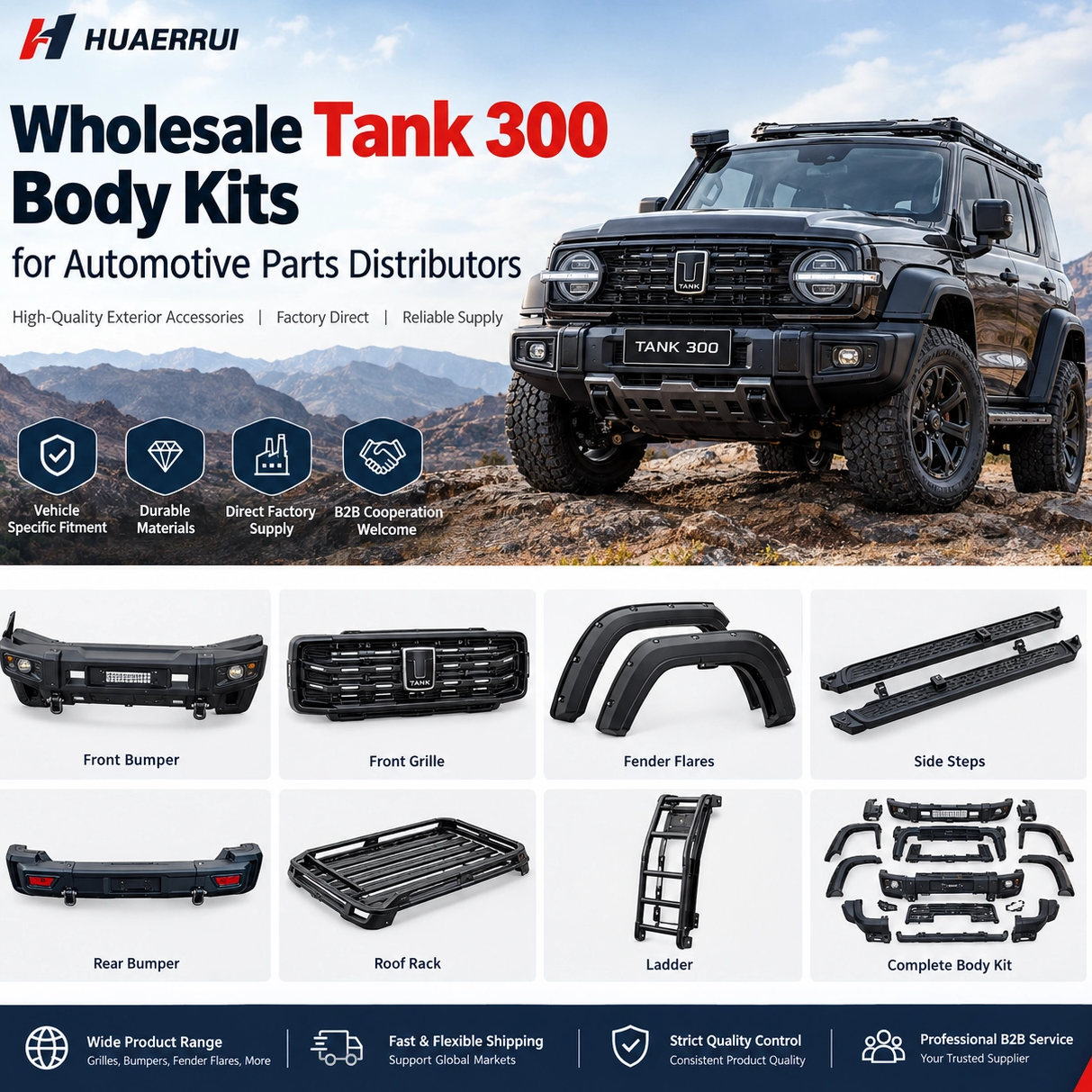 Wholesale Tank 300 Body Kits for Automotive Parts DistributorsIntroductionThe GWM Tank 300 has become a recognizable SUV platform in the automotive aftermarket, attracting interest from businesses specializing in off-road accessories, vehicle customization, and exterior styling upgrades. For automot
-
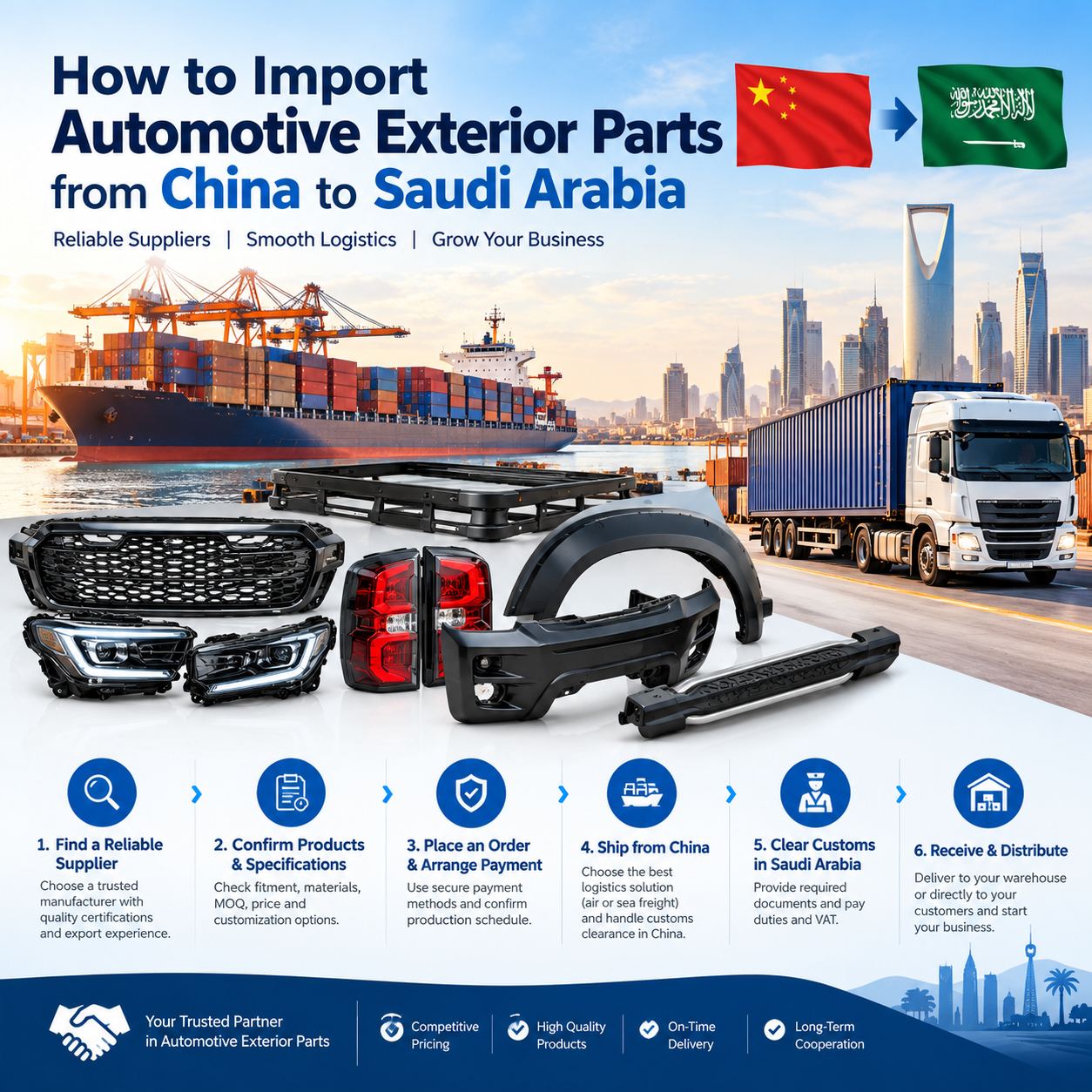 Saudi Arabia has a strong and growing market for pickup trucks, SUVs, 4x4 vehicles, and automotive modification products. For distributors, wholesalers, auto repair shops, and modification businesses, importing automotive exterior parts from China can provide access to a wide range of products, comp
-
 Importing automotive parts from China to Colombia can create valuable business opportunities for auto parts wholesalers, importers, distributors, repair shops, and automotive modification businesses. China offers a wide range of automotive products, including headlights, LED taillights, front grille

